

How to Become an AI Engineer in Tampa, FL in 2026
By Irene Holden
Last Updated: March 29th 2026
Quick Summary
To become an AI engineer in Tampa by 2026, embark on a structured 12-month journey from Python basics to mastering LLMs and MLOps, all while leveraging Tampa's no-state-income-tax advantage. The average salary of $110,557 goes further here, with local giants like Jabil and Raymond James actively seeking AI skills for their tech integrations. Focus on building a Tampa-centric portfolio project, like an AI economic dashboard, to tap into the region's growing AI startup scene and secure your place in this thriving market.
The Tampa Starting Point: More Than Just Tools
Before you can build an AI career, you need to understand the terrain. Tampa's AI landscape is defined by a powerful combination of major corporate investments, a supportive academic backbone, and a significant financial advantage for workers. The average AI developer salary in Tampa is $110,557, a figure that stretches much further thanks to Florida's no personal income tax. This isn't just a theoretical benefit; it's immediate, tangible value that boosts your effective earnings from day one.
The corporate demand is already here. Employers like Raymond James, Jabil, and ReliaQuest are actively seeking talent to integrate AI into finance, manufacturing, and cybersecurity. Meanwhile, the academic infrastructure is rapidly expanding to meet this need. The University of South Florida's Bellini College of Artificial Intelligence, Cybersecurity and Computing represents a $40 million local landmark investment, creating a pipeline of research and talent.
"AI integration is critical for Florida to become a top 10 global economy by 2030." - Florida Chamber of Commerce
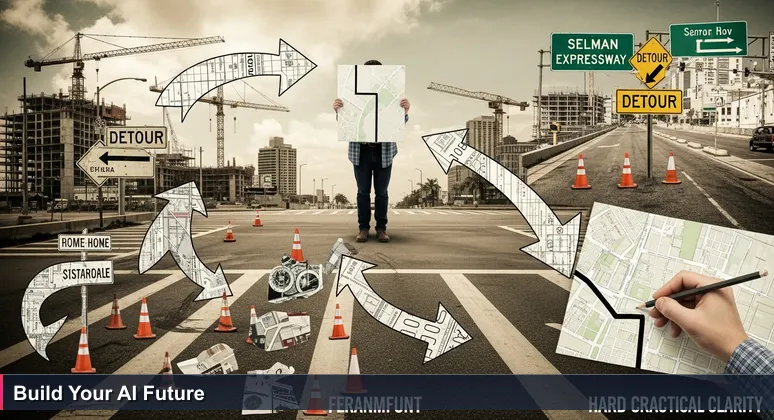
Your foundational toolkit is straightforward: a reliable computer, Python, and a structured learning path. But your mindset must be that of a navigator, not just a passenger. As industry experts note, we are in the era where AI is becoming "defaulted and embedded" into business workflows. Your journey is about building the situational awareness to connect universal technical skills to Tampa's specific opportunities in healthcare, finance, and defense tech, turning a generic map into a personalized route to a local career.
Steps Overview
- Lay Your Foundation in Tampa's AI Landscape
- Master Python for AI in Tampa Bay
- Build Software Engineering Skills
- Grasp Math and Traditional Machine Learning
- Dive into Deep Learning Frameworks
- Engineer with Large Language Models
- Deploy AI Models with MLOps
- Create a Tampa-Focused AI Portfolio Project
- Verify Your Readiness for Tampa's AI Job Market
- Common Questions
Nucamp offers a guide to AI careers in Tampa in 2026 with practical advice and local insights.
Master Python for AI in Tampa Bay
Python: Your First Tool for Tampa's Data
Python isn't just a recommended language; it's the non-negotiable entry point for AI engineering in Tampa. Every library, framework, and tool used by local employers from Raymond James to Jabil is built around it. Your first months should be dedicated to achieving fluency in core programming concepts and the specific libraries that turn raw data into insight.
Begin with a structured approach to Python syntax, data structures, and functions. Immediately layer on the essential data science libraries: Pandas for manipulation and NumPy for numerical operations. A local, cost-effective starting point can be an introductory course at Hillsborough Community College (HCC), which provides the foundational structure many beginners need.
- Master basic syntax, control flow, and functions.
- Learn to manipulate data with Pandas DataFrames.
- Perform numerical operations and array computing with NumPy.
Pro tip: Apply these skills to locally relevant data from the start. Write a script that reads a CSV of Tampa Bay housing prices from the Hillsborough County Property Appraiser public records, cleans the data with Pandas, and calculates average prices by neighborhood. This transforms abstract learning into a project that demonstrates understanding of both the tool and the Tampa market. The common mistake is rushing to run complex AI code without this bedrock - you'll lack the intuition to debug or innovate when things inevitably break.
Build Software Engineering Skills
From Scripts to Systems: The Engineering Mindset
An AI engineer in Tampa is first a software engineer. Companies like Jabil and ReliaQuest need professionals who can build reliable, deployable systems, not just experimental notebooks. This phase bridges coding with craftsmanship, focusing on the tools that enable collaboration and production.
- Git & GitHub: Every project, from day one, should live in a version-controlled repository. This is your professional ledger and a non-negotiable skill for any tech team in Tampa's collaborative ecosystem.
- API Development: Learn to build a simple REST API using Flask or FastAPI. This is how your future models will communicate with web apps, mobile clients, and other services.
- Basic Containerization: Understand Docker fundamentals. It packages your code and its environment so it runs identically anywhere - a critical skill for deployment in cloud or on-premise systems used by major Tampa employers.
Pro tip: Create a simple Flask API that serves a "Hello, Tampa!" message, then containerize it with Docker and push the image to a public repository. This end-to-end exercise mirrors the workflow you'll use in a professional setting. For a structured path that bundles these skills, consider focused programs like the USF Machine Learning Engineering and AI Bootcamp, designed to eliminate knowledge gaps through project-based learning.
Grasp Math and Traditional Machine Learning
Building Intuition: The Math Behind the Magic
Before you can effectively train models, you need an intuitive grasp of how they learn. This doesn't require a PhD, but a solid foundation in key mathematical concepts is non-negotiable. As one expert roadmap notes, understanding vectors, matrices, and gradients provides the language to comprehend advanced algorithms and diagnose their failures.
Focus on three core areas using resources like Khan Academy: linear algebra for data transformations, statistics for evaluating model performance, and calculus for understanding optimization. Immediately apply this theoretical knowledge by mastering the Scikit-learn library. Implement and compare algorithms like linear regression, decision trees, and random forests on Tampa-relevant datasets.
Practical Exercise: Build a model to predict customer churn for a fictional Tampa-based service company. Focus on the full pipeline: cleaning local demographic data, selecting features, training with Scikit-learn, and evaluating results. This mirrors the predictive analytics work done for local retail or financial firms.
"The Math Needed for AI/ML is often overstated, but you must understand gradients and partial derivatives to grasp how models learn." - Harry Connor AI, AI Educator
Warning: Avoid getting bogged down in deep mathematical proofs. Prioritize intuitive understanding and practical application. This applied approach is emphasized in local programs like the University of South Florida's Bachelor of Science in AI and the University of Tampa's Data Science major, which blend theory with hands-on implementation crucial for Tampa's job market.
Dive into Deep Learning Frameworks
The Engine of Modern AI: Neural Networks in Practice
Deep learning is the engine powering the most transformative AI applications, from medical image analysis at Tampa General Hospital to advanced diagnostics. Proficiency in building and training neural networks is now a non-negotiable requirement for engineers in our market. This is where you move from using pre-built models to architecting intelligent systems from the ground up.
Your focus should be on achieving fluency in one core framework: TensorFlow or PyTorch (increasingly favored in research for its flexibility). Learn to construct neural networks by defining layers, activation functions, loss metrics, and optimizers. This hands-on skill set is a cornerstone of advanced programs like those at the University of South Florida's Bellini College, which leverages over 200 faculty experts in AI and computing.
Practical Exercise: Build a convolutional neural network (CNN) to classify images. A perfect Tampa-relevant project trains a model to identify different species of local marine life from images taken in Tampa Bay. This demonstrates not only technical skill but also the ability to apply AI to Florida's unique environmental and economic ecosystems.
"2026 marks the year AI transitions into an everyday business default, particularly in clinical workflows and patient care." - Shaw, Industry Expert at the Florida Annual Jobs Summit
Mastering these frameworks equips you for high-value roles across the region. Whether optimizing supply chains for Jabil or developing new tools for the growing defense tech sector, your deep learning expertise, built under the Gulf Breeze of Florida's no-state-income-tax climate, becomes a powerful competitive advantage.
Engineer with Large Language Models
Harnessing the AI Revolution: From Chatbots to Intelligent Agents
The advent of Large Language Models (LLMs) like GPT-4 has fundamentally changed what businesses expect from AI engineers. Tampa employers, from fintech firms in Westshore to marketing startups in downtown Tampa, no longer just want data scientists - they need engineers who can productively harness these powerful models to build applications. This requires moving far beyond using a chatbot's web interface.
Your focus should be on three pillars of modern LLM engineering. First, master systematic prompt engineering to get reliable, structured outputs. Second, become proficient with Hugging Face, the essential hub for open-source models. Third, learn LangChain, the critical framework for chaining LLM calls with other data sources and tools to build robust, context-aware AI agents.
Practical Exercise: Build a "Tampa Business Assistant" AI agent using LangChain. Have it fetch recent local business news from an API, summarize trends using an LLM, and answer specific questions about the Tampa market. This directly mirrors the intelligent automation tools being developed for local venture capital firms and accelerators.
This specialized skill set is the entire focus of programs like the 25-week Solo AI Tech Entrepreneur Bootcamp from Nucamp, which teaches LLM integration, AI agent development, and building deployable products. For professionals seeking a shorter introduction, IA University's 4-week AI Thinking course provides a strategic foundation. Mastering these tools allows you to build the next generation of AI applications that Tampa's growing tech ecosystem is ready to fund and scale.
Deploy AI Models with MLOps
Crossing the Last Bridge: From Prototype to Production
A model trapped in a Jupyter notebook delivers zero business value. The final, critical skill is MLOps - the practice of deploying, monitoring, and maintaining models in production. This is the "engineering" capstone that Tampa employers like ReliaQuest and Jabil demand: the ability to build secure, reliable, and scalable AI systems.
Your focus shifts to the tools and processes that bring models to life. Master model deployment using the Flask or FastAPI skills you built earlier, or leverage cloud services like AWS SageMaker. Understand the basics of CI/CD pipelines tailored for machine learning to automate testing and updates. Crucially, learn model monitoring to track performance drift over time, ensuring your predictions remain accurate as Tampa's market data evolves.
Practical Exercise: Take your best predictive model and deploy it as a live web application.
- Package it with a Flask/FastAPI backend.
- Containerize the entire application using Docker.
- Create a simple front-end interface for user input.
- Deploy the containerized app to a cloud platform like Heroku or Render.
This end-to-end exercise mirrors the exact workflow used by local tech teams. For structured learning that bundles these DevOps skills with Python, the 16-week Back End, SQL and DevOps with Python bootcamp provides a cohesive path. As noted in industry discussions, the most future-proof engineers are those who can not only design algorithms but also ensure they deliver consistent value in real-world settings - bridging the final gap between theory and Tampa's operational reality.
Create a Tampa-Focused AI Portfolio Project
Your Proof of Mastery: A Project That Solves Local Problems
Throughout your learning journey, you should be building a portfolio. By month 12, this culminates in a single, comprehensive capstone project. One major, end-to-end application that solves a Tampa-relevant problem is worth more than a dozen tutorial clones. It transforms your GitHub from a collection of exercises into a compelling professional narrative.
A powerful example is an "AI-Powered Tampa Bay Economic Indicator Dashboard." This web application would ingest public data from sources like the Tampa Bay Economic Development Council or county real estate listings, use machine learning models to identify and forecast trends, and present actionable insights through an interactive interface.
This single project demonstrates your full-stack capability across four critical domains:
- Data Engineering: Automated collection and cleaning of diverse local datasets.
- Machine Learning: Implementing time-series forecasting or clustering analysis on Tampa's economic data.
- LLM Integration: Using a model to generate narrative, executive-style summaries of weekly trends.
- Software Engineering & MLOps: A deployed, containerized backend with a clean front-end, all version-controlled on GitHub.
It works because it solves a tangible, local problem - helping businesses and investors understand regional economic trends - while being technically complex. This is exactly the kind of applied, business-aligned thinking that impresses hiring managers at Raymond James, Bloomin' Brands, and Tampa Bay startups. As highlighted by local career services, employers favor candidates who can articulate how their skills apply to industry-specific challenges, moving you from a learner with a map to a navigator who builds valuable tools for the local landscape.
Verify Your Readiness for Tampa's AI Job Market
After months of dedicated learning, true readiness for Tampa's AI job market is measured by concrete benchmarks that local hiring managers use to separate candidates from contenders. As industry analysts highlight, the ability to use AI to solve common problems will be the single largest differentiator for career success in the coming decades.
- A Live, Deployed Project: Your portfolio must include at least one application that is publicly accessible online, not just code in a repository. This demonstrates you can cross the bridge from prototype to production, a non-negotiable for roles at firms like ReliaQuest or Jabil.
- Mastery of the Full Stack: You can articulately explain every component of your project’s pipeline, from data ingestion and model training to API deployment and user interaction, proving comprehensive technical ownership.
- GitHub is Your Resume: An active GitHub profile with clean, well-documented code and a consistent commit history tells the story of your technical journey and collaborative discipline, serving as your primary credential.
- You Speak "Tampa Business": You can directly connect your skills to local industry pain points, such as building fraud detection models for finance or predictive maintenance for manufacturing. With nearly 12% of Tampa jobs at high risk from AI automation, this business acuity shows you understand the urgency driving local investment.
- You Embrace Continuous Learning: You recognize, as the Florida Chamber of Commerce emphasizes, that AI integration is critical for the state's economic future, and you commit to navigating the ongoing "construction zones" in technology.
Meeting these criteria transforms you from a follower of roadmaps into a navigator of Tampa's tech landscape. For further refinement, leverage resources like the USF AI Career Toolkit to align your portfolio with regional opportunities. The destination is a rewarding career in a tax-advantaged metro where you don't just understand AI - you engineer the solutions building its future.
Common Questions
How can I become an AI engineer in Tampa by 2026 if I have no prior experience?
It's achievable with a structured 12-month plan that builds skills from scratch, starting with Python and progressing to AI deployment. In Tampa, the average AI engineer salary is around $110,557, and with Florida's no state income tax, your earnings go further, making the journey worthwhile for local opportunities.
Do I need a computer science degree to get hired as an AI engineer in Tampa?
Not necessarily - many employers like Raymond James and Jabil value practical skills and portfolios over degrees alone. Bootcamps such as Nucamp's offer focused training, and local resources like USF's programs can provide alternatives, especially in Tampa's growing tech ecosystem.
What if I struggle with the math required for AI and machine learning?
Start with intuitive learning through platforms like Khan Academy, focusing on practical application rather than deep theory. In Tampa's job market, problem-solving with AI tools - like building models for local data - is often more critical than advanced math, helping you succeed without a strong background.
Are there local bootcamps or courses in Tampa that can speed up my path to AI engineering?
Yes, Tampa offers accelerated options like Nucamp's Solo AI Tech Entrepreneur Bootcamp, which provides hands-on projects aligned with local industry needs. This can help you build a portfolio quickly, leveraging the startup scene in areas like USF Research Park for faster career entry.
How does Tampa's job market and tax advantage compare to other cities for AI engineers?
Tampa's AI job market is thriving with employers like Publix and Bloomin' Brands, offering competitive roles. Plus, Florida's no state income tax means salaries like the $110,557 average yield higher take-home pay, giving you an edge over tech hubs with higher taxes.
Read this comprehensive analysis of cybersecurity hiring trends in Tampa, FL for 2026.
Read about non-degree tech careers in Tampa Bay for 2026 and the employers leading the change.
This resource features a comprehensive list of Tampa startups seeking junior talent in 2026, based on mentorship and growth.
Understand the state of Tampa's tech industry in 2026 with this article.
For a detailed analysis, see the list of top 10 industries hiring AI in Tampa beyond big tech.

Irene Holden
Operations Manager
Former Microsoft Education and Learning Futures Group team member, Irene now oversees instructors at Nucamp while writing about everything tech - from careers to coding bootcamps.