


The Complete Guide to Starting an AI Career in Minneapolis, MN in 2026
By Irene Holden
Last Updated: March 16th 2026

Key Takeaways
To start an AI career in Minneapolis in 2026, focus on building specialized skills for the Twin Cities' robust corporate and healthcare sectors, where median salaries reach around $116,000 and roles like AI/ML Engineer can earn over $180,000 with experience. Practical training through programs like Nucamp's bootcamps or the University of Minnesota's AI Hub is key to standing out in this competitive market driven by employers such as Target and UnitedHealth Group.
In the 2026 Minneapolis job market, artificial intelligence has moved from the lab to the clinic. Employers are no longer testing for textbook definitions; they are evaluating candidates on their ability to diagnose complex business problems and prescribe precise, implementable technical solutions. This shift has created a state of market recalibration, where basic coding proficiency is merely table stakes.
The demand is concrete and localized. Analysis by The Right Staff reveals that approximately 12.3% of all Computer & Mathematical occupation postings in the Twin Cities now explicitly require specific AI skills. This reflects a diverse corporate base - from Target and UnitedHealth Group to U.S. Bank and 3M - that is aggressively integrating AI to solve operational challenges, creating a robust and varied demand for specialized talent.
This intensity, however, has introduced a new screening challenge for employers. A January 2026 survey by CareerForce MN found that while 73% of Minnesota hiring managers are confident in their outlook, 65% report that AI-generated, generic applications are making it significantly harder to identify genuinely qualified candidates. As James Holmberg, Co-founder of local firm Vilas AI, observed about the AI leap: "I don't think these things [jobs] go away. I think they actually get leaner... they just get more intense."
The clear message for job seekers is that superficial knowledge and AI-assisted resumes are insufficient. The currency of the 2026 market is depth, specificity, and the proven ability to apply technical skill to the unique pathology of a Minneapolis industry. Your first task is to shift your mindset from student to practitioner, analyzing local business news for specific operational challenges at major employers that an AI solution could treat.
In This Guide
- Understanding Minneapolis's 2026 AI Job Market
- The Twin Cities AI Ecosystem
- AI Career Paths and Salaries
- Building Your AI Skill Set
- Education and Portfolio Development
- Job Search Strategy for 2026
- Long-Term Career Development in AI
- Frequently Asked Questions
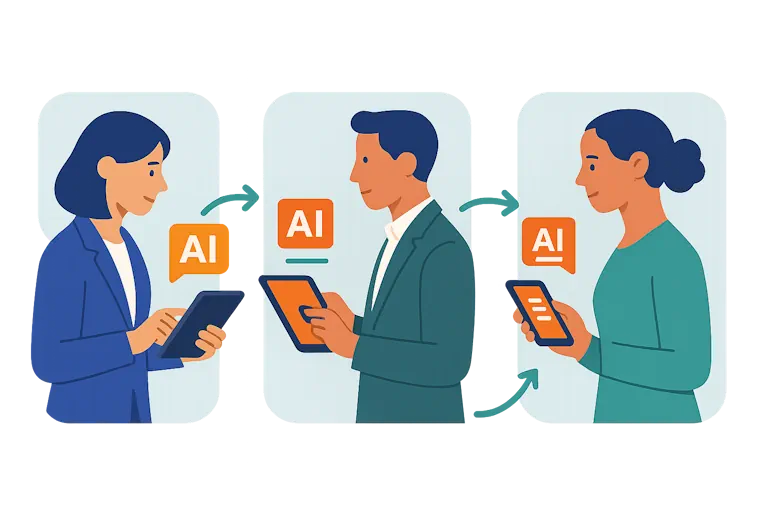
The tech training scene in Minneapolis continues to grow as more startups and corporate R&D centers expand in the Twin Cities.
The Twin Cities AI Ecosystem
Major Corporate Hubs: The Pillars of Demand
The Twin Cities economy is powered by distinct industry clusters, each with its own AI application frontier. In the western suburbs, a renowned "MedTech corridor" thrives, anchored by UnitedHealth Group/Optum and Medtronic, which deploy AI for diagnostics and clinical informatics. The retail sector is dominated by Target and Best Buy, using AI for hyper-personalization and supply chain logistics. Meanwhile, finance giants like U.S. Bank focus on fraud detection and process automation.
The Startup & Research Engine: Fueling Innovation
Beyond the corporate giants, a vibrant startup scene drives specialized innovation. In 2026, twelve Minnesota startups were highlighted as ones to watch, with a prevailing trend favoring the development of "killer applications" using existing AI models over building foundational ones from scratch. This innovation is academically anchored by the University of Minnesota's Artificial Intelligence Hub, launched in March 2026 to drive statewide strategy, education, and workforce development.
The ecosystem creates a unique advantage: rather than a single-tech monoculture, Minneapolis offers a diversified portfolio of high-impact AI problems to solve. From healthcare data in Maple Grove to retail analytics in Brooklyn Park, the local playing field is rich with opportunity for those who learn its specific pathology. Your effectiveness as a candidate hinges on targeting your skills toward one of these concrete sectors.
AI Career Paths and Salaries
Specialized Roles Define the Market
The Minneapolis AI job market in 2026 has matured beyond generic titles, crystallizing into specialized engineering and strategic pathways. Companies are hiring for precision, seeking experts who can own specific segments of the AI development lifecycle, from system architecture to data pipeline engineering.
| Role | Low (Entry/Limited Exp.) | Mid (Moderate Exp.) | High (Extensive Exp.) |
|---|---|---|---|
| AI Architect | $152,743 | $187,250 | $210,523 |
| AI/ML Engineer | $143,380 | $182,703 | $206,778 |
| Data Scientist | $130,273 | $164,513 | $195,275 |
| AI/ML Analyst | $127,598 | $155,953 | $186,180 |
| Generative AI Engineer | $82,300 | $113,479 | $134,669 |
According to aggregated data from sources like Robert Half, the AI/ML Engineer remains the highest-volume specialized posting, involving end-to-end model deployment. The Data/Retrieval Engineer is a role gaining critical importance for powering reliable Large Language Model applications. Notably, the median wage for all "Artificial Intelligence" titled roles in Minneapolis is approximately $116,300/year, as reported by ZipRecruiter.
These salaries reflect the high-stakes, production-focused nature of the work at local Fortune 500 companies and startups. An entry-level Generative AI Engineer might start near $82k, but with experience building systems for Target's personalization or Optum's clinical tools, compensation rapidly advances into the upper tiers, rewarding those with proven diagnostic and treatment skills.
Building Your AI Skill Set
Foundational Technical Competencies: The Core Curriculum
Mastering the tools of the trade is non-negotiable. In Minneapolis, Python proficiency is essential, with Java also highly valued in enterprise environments like Target’s. You must be fluent in core frameworks such as PyTorch and TensorFlow, as well as libraries like scikit-learn and Hugging Face Transformers. Crucially, the ability to deploy models separates prototype builders from production engineers. Hands-on experience with cloud platforms (AWS SageMaker, Google Vertex AI, Azure ML) and MLOps practices - CI/CD, containerization with Docker, and model serving - is a standard requirement.
The 2026 Differentiator: AI-Native Problem Solving
Technical skills grant admission, but strategic thinking secures success. Employers seek candidates who can critically evaluate model limitations, creatively integrate AI into existing workflows, and apply what a 2026 LinkedIn report on AI skills highlights as AI literacy - the ability to assess new tools for practical business utility. As Mike Hudy, Chief Science Officer, emphasizes, AI functions best as a tool augmenting "lived experience," not replacing it.
This means for every technical skill you learn, you must pair it with a business question. Don't just learn PyTorch; learn how to build a recommendation engine that could solve a specific inventory problem for a retailer like Best Buy. Your value lies in your diagnostic ability to match the correct technical prescription to a Minneapolis company's unique symptom.
Education and Portfolio Development
Formal and Accelerated Learning Pathways
In 2026, demonstrating competency requires both credible education and a practical portfolio. For deep theoretical foundations, the University of Minnesota's AI Hub offers degrees and certificates designed with industry. For those needing job-ready skills on an accelerated timeline, intensive bootcamps are a strategic choice. Programs like Nucamp's 25-week Solo AI Tech Entrepreneur Bootcamp ($3,980) focus on building and shipping AI products - ideal for joining Twin Cities startups focused on "killer applications."
Building Your Clinical Portfolio: The Case Log
Your portfolio must be a documented log of solved problems, not tutorial repeats. Structure it to prove diagnostic skill:
- Project 1 (The Diagnosis): Analyze a public dataset relevant to a local industry, like State of Minnesota health data, and articulate a clear business problem.
- Project 2 (The Treatment): Build and deploy a functional model addressing that problem, using a cloud service like AWS or Azure to create a simple API.
- Project 3 (The Specialization): Go deep on a domain, such as building a computer vision model for medical imagery if targeting MedTech.
Your educational path should directly fuel this portfolio. Whether through a university program or a practical bootcamp, the curriculum must culminate in demonstrable projects that speak directly to the pathologies of the Minneapolis market, turning your learning into a tangible treatment plan for employers.
Job Search Strategy for 2026
Think of your 2026 job search not as sending out resumes, but as beginning your clinical rounds - an immersive process of diagnosis and connection within the Twin Cities ecosystem. Success here is often found through the region's tight-knit professional networks. Attend events hosted by MinneAnalytics or TECHdotMN not to collect contacts, but to engage in deep conversations about sector-specific challenges. As local professionals note, many find roles through "friend groups and networks," valuing the region's pace for "deep independent technical learning."
You must then optimize your application for human reviewers, not bots. With 65% of hiring managers reporting that AI-generated applications clutter their search, as noted in a CareerForce MN survey, use AI as an editor, not a writer. Infuse your materials with specific local keywords like "supply chain optimization for retail" or "clinical informatics pipeline" and quantifiable results from your portfolio projects.
Finally, prepare for an interview format that tests applied judgment. Expect system design challenges for local use cases ("Design a real-time fraud detection system for U.S. Bank"), ethical scenario discussions on bias mitigation, and rigorous deep dives into every decision within your portfolio case log. Your goal is to demonstrate you're not just technically proficient, but that you understand the business physiology of the Twin Cities.
Long-Term Career Development in AI
The Foundation Years (0-2): Technical Mastery and Domain Immersion
Your initial years function as a clinical residency. Focus on achieving mastery within your core technical stack - whether that’s MLOps at Target or NLP pipelines at Optum - while deeply absorbing the business domain of your employer. This period is about building a reputation for reliability and learning to translate between technical and business teams. Seek out a mentor within the organization who can guide you through the unique corporate physiology of your company, accelerating your understanding of which problems are worth solving.
The Specialization Phase (3-5): From Practitioner to Expert
As you move into a fellowship-like phase, your value shifts from general competency to deep, sought-after expertise. This is when you become the go-to person for computer vision in medical devices at Boston Scientific or the authority on retrieval-augmented generation systems within a local fintech. You begin mentoring junior engineers and contributing to architectural discussions. Your compensation reflects this specialization, with salaries for roles like AI Architect reaching into the $210,000 range, as detailed in local salary surveys.
The Strategic Leadership Stage (5+): Architecting the Future
At the attending or practitioner level, your role evolves from building solutions to defining strategy. You may advance into an AI Architect role, a specialized AI Product Manager, or lead an entire ML engineering team. Your value is in diagnosing high-level business challenges and prescribing the overarching technical vision. As emphasized in industry analysis, the lifespan of specific technologies continues to shorten, making commitment to ongoing reskilling through platforms like the University of Minnesota AI Hub non-negotiable for sustained leadership.
The long-term prognosis for an AI career in Minneapolis is exceptionally strong, anchored by the region’s diverse, innovation-driven economy. By embracing continuous learning and evolving from a technician to a strategic diagnostician, you build more than a job - you cultivate a resilient, impactful practice at the heart of the Twin Cities’ intelligent future.
Frequently Asked Questions
Is 2026 a good time to start an AI career in Minneapolis?
Yes, the Twin Cities market is robust, with about 12.3% of computer and math job postings requiring AI skills in 2026. Employers are actively seeking specialists to solve specific business problems, driven by our strong corporate base in healthcare, retail, and finance.
What salaries can I expect for AI roles in Minneapolis in 2026?
Salaries are competitive, with a median wage of $116,300 per year for AI roles. For instance, AI/ML Engineers in the metro area can earn from $143,380 to over $206,778 annually, depending on experience and specialization at companies like Target or UnitedHealth Group.
Which companies in Minneapolis are hiring the most for AI positions?
Major employers include Fortune 500 giants like Target, UnitedHealth Group, and U.S. Bank, along with MedTech leaders such as Medtronic and Boston Scientific. The growing startup scene and University of Minnesota's AI Hub also fuel demand for talent in specific applications.
Do I need a degree to get into AI in Minneapolis, or are bootcamps enough?
Multiple pathways exist: formal degrees from institutions like the U of M's AI Hub provide deep foundations, but bootcamps like Nucamp's offer accelerated, practical training focused on job-ready skills. Employers value demonstrable abilities, so a strong portfolio from either route can be effective.
What skills should I prioritize for AI jobs in the Twin Cities in 2026?
Focus on technical proficiencies like Python, PyTorch, and cloud deployment with AWS or Azure, plus data engineering skills. Equally important is AI-native problem-solving - thinking critically to apply these tools to local industry challenges, such as retail optimization or healthcare diagnostics.
This guide to affordability in the Twin Cities for tech professionals in 2026 covers salary benchmarks and expenses.
Get assistance with free library tech help in Minneapolis through various programs.
For insights on AI salaries in Minneapolis for 2026, refer to this guide.
This guide covers the best places for tech collaboration in Minneapolis in 2026, from corporate hubs to startup garages.
Discover the top 10 companies hiring AI engineers in Minneapolis, MN in 2026 for career insights.

Irene Holden
Operations Manager
Former Microsoft Education and Learning Futures Group team member, Irene now oversees instructors at Nucamp while writing about everything tech - from careers to coding bootcamps.